
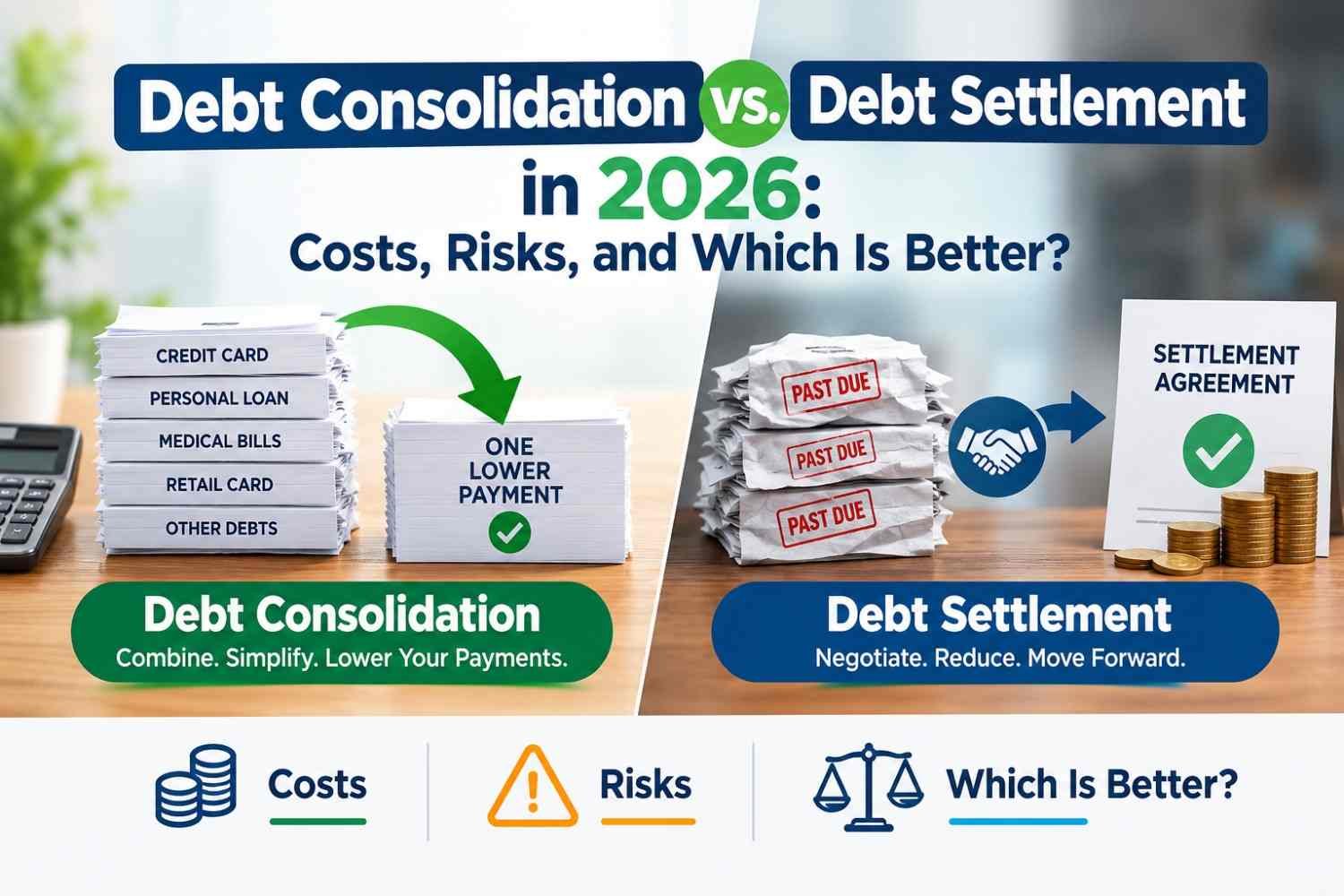
Managing high-interest debt can become challenging when credit card balances, personal loans, and other monthly obligations consume a significant portion of your income. If you are struggling to keep up with payments, you may be considering debt consolidation or debt settlement.
Although both options can help borrowers address debt problems, they work in very different ways. Debt consolidation generally combines multiple debts into a new loan or credit account, while debt settlement involves negotiating with creditors to accept less than the full amount owed.
Understanding the differences between debt consolidation vs debt settlement is essential before choosing a debt relief strategy. The wrong decision could increase your borrowing costs, damage your credit score, or leave you with additional fees.
In this guide, we compare debt consolidation and debt settlement in 2026, including their costs, benefits, risks, credit score implications, and alternatives. You will also learn how to evaluate debt relief companies and determine which option may fit your financial circumstances.
What Is Debt Consolidation?
Debt consolidation is a financial strategy that combines multiple debts into a single repayment arrangement. Borrowers often use a debt consolidation loan or a balance transfer credit card to pay off high-interest credit card balances and other eligible unsecured debts.
The main objective is to simplify repayment and, when possible, reduce the total interest paid.
For example, if you have three credit cards with different interest rates and payment dates, you might qualify for a personal loan with a lower annual percentage rate (APR). You could use that loan to repay the cards and then make one scheduled payment toward the new loan.
However, debt consolidation does not eliminate your debt. You are still responsible for repaying the amount borrowed, along with applicable interest and fees.
Common Debt Consolidation Options
1. Debt Consolidation Loans
A personal loan used for debt consolidation provides funds to repay eligible existing debts. You then repay the new loan according to its interest rate, repayment term, and monthly payment schedule.
Compare the APR, origination fees, repayment period, and total amount payable before accepting an offer.
2. Balance Transfer Credit Cards
Some credit cards offer promotional low-interest or 0% APR periods for eligible balance transfers. These offers may help borrowers reduce interest costs if they repay the transferred balance before the promotional period expires.
Balance transfer fees and the regular APR after the promotional period can affect the overall savings.
3. Home Equity Loans and HELOCs
Homeowners with sufficient equity may consider borrowing against their property to repay other debts. These options can have different rates and repayment structures, but they introduce an important risk: your home may be at risk if you cannot meet the secured loan’s repayment obligations.
4. Debt Management Plans
A nonprofit credit counseling agency may help you establish a debt management plan. Depending on the creditors and terms, the plan may simplify payments or secure reduced interest rates. Unlike debt settlement, a debt management plan generally focuses on repaying the debt rather than negotiating away a portion of the principal.
What Is Debt Settlement?
Debt settlement is a process in which a creditor agrees to accept less than the full amount owed to satisfy a debt.
Borrowers may negotiate directly with creditors or work with a debt settlement company. These companies typically attempt to negotiate reduced balances on eligible unsecured debts, such as credit card debt.
For instance, suppose you owe $15,000 on an eligible unsecured debt. A creditor might agree to accept a smaller amount under a negotiated settlement. However, no particular reduction is guaranteed, and the creditor is not required to accept a settlement proposal.
Debt settlement can be especially risky when a company advises you to stop making payments while saving money for a future settlement. Missed payments can result in additional interest, late fees, collection activity, credit score damage, and potential lawsuits.
The Consumer Financial Protection Bureau (CFPB) warns that debt settlement can leave consumers in a worse financial position when accumulated charges and unsuccessful negotiations outweigh any savings.
Before enrolling in a debt settlement program, compare the company’s fees, understand the risks, and consider alternatives such as direct creditor negotiations or nonprofit credit counseling.
Debt Consolidation vs. Debt Settlement: Key Differences
The following comparison summarizes the main differences between these two debt relief options.
| Feature | Debt Consolidation | Debt Settlement |
|---|---|---|
| Primary purpose | Combine debts into one repayment arrangement | Negotiate to pay less than the full amount owed |
| Debt principal | Usually remains payable in full | May be reduced if a creditor agrees |
| Interest costs | Depends on the new loan or account terms | Interest and charges may continue while debts remain unpaid |
| Common fees | Loan origination or balance transfer fees | Settlement company fees and possible account fees |
| Credit score impact | May cause a temporary decline; results vary | Missed payments and settled accounts can cause significant damage |
| Payment structure | Usually scheduled monthly payments | May require accumulated savings and lump-sum or agreed settlement payments |
| Creditor participation | A lender approves the new borrowing arrangement | Each creditor decides whether to accept a settlement |
| Best potential fit | Borrowers who can afford repayment and qualify for favorable terms | Borrowers facing serious repayment difficulty who understand the risks |
| Main risk | Higher total cost or additional debt if spending continues | Credit damage, growing balances, collection actions, and unsuccessful negotiations |
Neither strategy is automatically better for every borrower. Your income, credit history, current interest rates, ability to repay, and financial goals should guide the decision.
Debt Consolidation Costs in 2026
The cost of debt consolidation depends on the financial product you choose.
A personal loan may charge interest and an origination fee. A balance transfer credit card may charge a fee based on the transferred balance. Home equity borrowing can involve closing costs and other expenses.
Consider this illustrative example.
Suppose you have $12,000 in credit card debt at an APR of 25%. You qualify for a debt consolidation loan at a 14% APR with a three-year repayment term.
If you repay the original balance over the same period under both scenarios, the lower-rate loan could reduce interest costs. However, the actual savings depend on the amortization schedule, fees, repayment timing, and loan approval terms.
Before choosing a loan, compare:
- The APR, including applicable fees.
- The total repayment amount over the full term.
- Any origination or account fees.
- Whether the interest rate is fixed or variable.
- Monthly payments and the repayment period.
- Penalties or charges for late payments, where applicable.
A lower monthly payment does not necessarily mean a cheaper loan. Extending repayment over a longer period can increase the total interest paid, even when the monthly payment decreases.
Debt Settlement Fees and Hidden Costs
Debt settlement companies may charge substantial fees for negotiating with creditors. Their pricing methods vary, so you should understand the fee calculation before signing an agreement.
Some companies calculate fees based on the amount of debt enrolled, while others use different contract structures. Do not assume that a quoted settlement amount represents your total cost.
For example, suppose a company quotes a settlement of $7,000 on a $10,000 debt. The apparent reduction is $3,000 before considering fees, accumulated interest, late charges, taxes, and other expenses.
If additional costs exceed the apparent savings, the settlement may provide little financial benefit or even increase your total cost.
Before enrolling, ask the company:
- How are fees calculated, and when can they be charged?
- What happens if creditors reject the settlement offers?
- Will interest and late fees continue accumulating?
- Are separate account administration fees involved?
- What happens if you cannot afford the required settlement payment?
- Could forgiven debt have federal or state tax consequences?
In the United States, the FTC’s Telemarketing Sales Rule restricts covered debt relief providers from charging fees before they achieve the required results and other conditions are met. Verify the rules that apply to the specific service and sales method.
Be cautious of any company that guarantees a specific percentage of debt reduction or promises to eliminate every debt.
How Debt Consolidation Affects Your Credit Score
Debt consolidation can affect your credit score in several ways, depending on the account type and your credit history.
Applying for a new loan may result in a hard credit inquiry. Opening a new account can also change your credit profile. Paying off credit card balances may reduce credit utilization, which can help your score in some circumstances.
However, these benefits are not guaranteed.
To improve the chances of a positive long-term outcome:
- Make every required payment on time.
- Avoid accumulating new credit card balances after consolidating existing debt.
- Compare loan terms carefully before applying.
- Monitor your credit reports for errors.
- Follow a realistic budget that supports consistent repayment.
Debt consolidation works best as part of a broader repayment plan rather than as a reason to borrow more money.
How Debt Settlement Affects Your Credit Score
Debt settlement can negatively affect your credit history, especially when the process involves missed payments.
Creditors may report delinquent accounts, and collection activity may occur while negotiations continue. A settled account may also be reported differently from an account repaid according to its original terms.
The impact depends on your existing credit history, the creditor’s reporting practices, and how the settlement is handled.
If you are already behind on payments, the damage may have begun before you consider settlement. Nevertheless, stopping payments can create additional problems.
Before deciding, ask whether you can negotiate directly with the creditor, request a hardship program, or work with a nonprofit credit counselor.
Pros and Cons of Debt Consolidation
Advantages
- Simplified repayment: Multiple eligible balances can become one monthly payment.
- Potential interest savings: A lower APR may reduce the cost of repaying debt.
- Predictable schedule: Fixed-rate loans generally provide a defined repayment schedule.
- Credit management: Paying balances down and making payments on time may support credit recovery.
- Less administrative complexity: One payment can be easier to manage than several separate due dates.
Disadvantages
- Approval requirements: Favorable rates may require a stronger credit profile and sufficient income.
- Fees: Origination and balance transfer fees can reduce potential savings.
- Longer repayment costs: Lower monthly payments may result from extending the loan term.
- Continued debt obligations: Consolidation does not forgive the balance.
- Risk of new borrowing: Using newly available credit can leave you with more debt than before.
Pros and Cons of Debt Settlement
Advantages
- Potential balance reduction: A creditor may agree to accept less than the full amount owed.
- Possible alternative to other options: Settlement may be worth evaluating when full repayment is no longer realistic.
- Negotiation flexibility: Some creditors may consider a lump-sum offer or an alternative payment arrangement.
- Direct negotiation is possible: You can contact creditors yourself rather than automatically hiring a settlement company.
Disadvantages
- Credit score damage: Missed payments and settlement reporting may harm your credit history.
- Uncertain results: Creditors are not required to accept settlement offers.
- Additional costs: Fees, interest, and late charges may reduce savings.
- Collection and legal risks: Creditors may continue collection efforts or pursue legal action.
- Potential tax liability: Certain canceled debts may be taxable unless an exclusion or exception applies.
Debt settlement should not be treated as guaranteed debt forgiveness. Evaluate the total financial consequences before entering an agreement.
Debt Consolidation vs. Debt Settlement: Which Is Better?
The right choice depends on how much you owe, whether you can afford monthly payments, and whether you qualify for better borrowing terms.
Debt Consolidation May Be Better If:
- You have several high-interest credit card balances.
- Your income is sufficient to support regular monthly payments.
- You qualify for a loan with a lower APR than your existing debts.
- You want a structured repayment plan.
- You can avoid taking on new high-interest debt.
In these circumstances, a debt consolidation loan or a suitable balance transfer card may simplify repayment and potentially lower borrowing costs.
Debt Settlement May Be Worth Evaluating If:
- You cannot realistically afford your existing unsecured debt payments.
- You are experiencing serious financial hardship.
- You have explored creditor hardship programs and other repayment options.
- You understand the potential credit damage and collection risks.
- You can evaluate the complete settlement cost, including fees and possible taxes.
Before hiring a debt settlement company, consider speaking directly with creditors or consulting a qualified nonprofit credit counselor.
What If Neither Option Is Suitable?
You may have other options, including a debt management plan, a revised household budget, direct creditor negotiations, or advice from a bankruptcy attorney.
Bankruptcy is a legal process with significant consequences, and eligibility depends on your circumstances. If repayment is no longer realistic, professional advice can help you understand the available alternatives.
Alternatives to Debt Consolidation and Debt Settlement
1. Nonprofit Credit Counseling
A nonprofit credit counseling agency can review your finances, help create a budget, and explain possible repayment strategies.
Some agencies offer debt management plans that may simplify payments or secure lower interest rates through participating creditors. Ask about fees, services, and accreditation before enrolling.
2. Direct Creditor Negotiation
Contact your lender before the situation becomes more difficult. Explain your financial hardship and ask about reduced interest rates, temporary payment relief, hardship programs, or a repayment arrangement.
If a creditor agrees to change the terms, obtain written confirmation before making payments under the new arrangement.
3. Debt Avalanche Method
The debt avalanche method prioritizes the balance with the highest interest rate while maintaining required payments on other debts.
Once the highest-interest debt is repaid, direct the extra payment toward the next-highest-rate balance. This method can reduce interest costs when followed consistently.
4. Debt Snowball Method
The debt snowball method prioritizes the smallest balance first while maintaining required payments on other accounts.
Paying off smaller balances may provide motivation, although this approach can cost more interest than the avalanche method depending on the balances and rates involved.
5. Bankruptcy Advice
If your debts are unaffordable and other repayment strategies are not realistic, consider speaking with a qualified bankruptcy attorney. They can explain eligibility, legal protections, potential asset implications, and the long-term consequences under applicable law.
How to Choose a Reliable Debt Relief Company
Choosing a reputable provider is important when evaluating debt consolidation or debt settlement services.
Use the following checklist before signing an agreement.
Verify the company’s credentials. Check its legal identity, contact information, complaint history, and any required state registrations or licenses.
Understand all fees. Request a written breakdown of service charges, account fees, and any other costs.
Avoid upfront-fee promises. Be especially cautious of debt relief companies that demand payment before delivering the promised settlement results.
Question guaranteed savings. No company can guarantee that every creditor will accept a reduced settlement or that a particular percentage of debt will be forgiven.
Read the agreement carefully. Understand cancellation terms, payment arrangements, and what happens if negotiations fail.
Compare alternatives. Review offers from lenders, nonprofit credit counseling agencies, and creditors directly before deciding.
The CFPB and Federal Trade Commission provide consumer guidance on identifying debt relief scams and understanding your rights.
Frequently Asked Questions
Is debt consolidation better than debt settlement?
Debt consolidation may be preferable if you can afford repayment and qualify for a lower interest rate. Debt settlement may be worth evaluating when you cannot realistically repay your unsecured debts in full. Both options have risks, so compare the complete costs before choosing.
Does debt settlement hurt your credit score?
It can. Missed payments, delinquent accounts, collection activity, and the reporting of settled debts may damage your credit history. The extent of the impact depends on your individual circumstances.
How much do debt settlement companies charge?
Fees vary by provider and contract. Some companies calculate fees based on enrolled debt or settled debt, while others use different structures. Ask for a written fee schedule and calculate the total cost before enrolling.
Can I negotiate debt settlement on my own?
Yes. You can contact your creditor or debt collector directly to discuss a settlement or repayment plan. Confirm the amount owed, make an affordable proposal, and obtain the agreement in writing before paying.
Is forgiven debt taxable in the United States?
Certain canceled debts may count as taxable income, although exceptions and exclusions can apply. The treatment depends on the circumstances. Consult IRS guidance or a qualified tax professional before assuming that forgiven debt is tax-free.
Does debt consolidation eliminate debt?
No. Debt consolidation combines existing balances into a new repayment arrangement. You generally remain responsible for repaying the full amount, including applicable interest and fees.
Can creditors sue me during debt settlement?
Yes. Depending on the circumstances and applicable law, creditors may pursue collection or file a lawsuit while negotiations are ongoing. Debt settlement does not automatically stop collection actions or legal proceedings.
What is the safest way to get out of credit card debt?
There is no single solution for everyone. Options include paying down high-interest balances, negotiating directly with creditors, using a suitable consolidation loan, or obtaining nonprofit credit counseling. Choose a strategy that fits your budget and does not create additional unaffordable obligations.
Final Verdict: Debt Consolidation vs. Debt Settlement in 2026
Debt consolidation and debt settlement serve different financial needs.
Debt consolidation may be the more practical option for borrowers who can afford regular payments and qualify for favorable loan terms. It can simplify repayment and potentially reduce interest costs, but it does not eliminate the debt.
Debt settlement may be an option for borrowers facing serious financial hardship who cannot realistically repay their unsecured debts in full. However, it carries substantial risks, including credit score damage, additional charges, collection activity, possible lawsuits, and potential tax consequences.
Before making a decision, compare the total repayment cost, evaluate your budget, and explore direct creditor negotiations or nonprofit credit counseling.
The best debt relief strategy is not necessarily the one that promises the biggest reduction. It is the one that provides a realistic path toward financial stability while minimizing unnecessary costs and risks.