
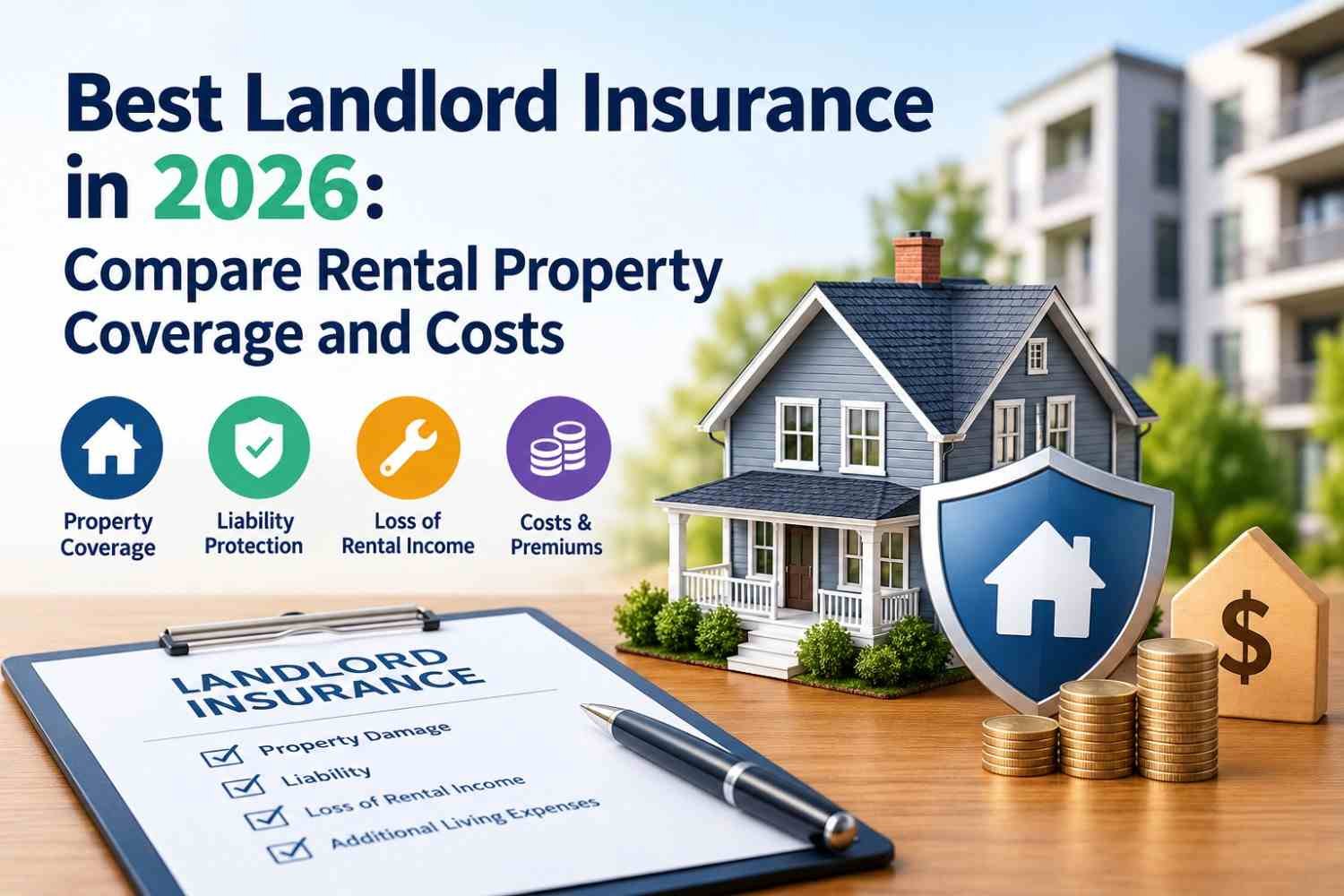
Owning a rental property can provide a steady income stream, but it also comes with financial risks. Property damage, tenant-related liability claims, unexpected repairs, and lost rental income can affect the profitability of a real estate investment.
Choosing the best landlord insurance can help property owners protect their rental homes, manage unexpected expenses, and reduce the financial impact of covered losses.
However, not every landlord insurance policy offers the same protection. Some policies focus on basic property damage, while others offer additional options for liability protection, loss of rental income, vandalism, and multiple rental properties.
In this guide, we compare leading landlord insurance companies in 2026, explain rental property insurance coverage, discuss the factors that influence premiums, and outline how to compare landlord insurance quotes.
Whether you own a single-family rental home, a condominium, or several investment properties, understanding these differences can help you make a more informed insurance decision.
What Is Landlord Insurance?
Landlord insurance is a type of property insurance designed for owners who rent residential properties to tenants.
It is sometimes called rental property insurance or rental dwelling insurance. Unlike standard homeowners insurance intended for an owner-occupied home, landlord insurance is designed around the risks associated with renting a property to other people.
Depending on the policy, landlord insurance may cover:
- Dwelling protection: Repairs or rebuilding costs after covered damage to the rental property’s structure.
- Other structures: Certain detached garages, fences, sheds, or similar structures.
- Landlord liability insurance: Eligible legal liability and associated costs if the landlord is held responsible for covered injuries or property damage.
- Loss of rental income: Certain lost rental income when a covered event makes the property uninhabitable.
- Landlord personal property: Certain equipment and furnishings owned by the landlord and used to maintain or operate the rental property.
Coverage limits, exclusions, deductibles, and optional protections vary by insurer and policy.
Landlord insurance generally does not replace a tenant’s renters insurance. Tenants typically need their own policy to protect their personal belongings and obtain personal liability coverage.
Best Landlord Insurance Companies in 2026
The best landlord insurance company for you depends on your property type, location, coverage needs, deductible preference, and budget.
The following companies are worth researching when comparing rental property insurance in the United States. These are suggested options to investigate rather than a guaranteed ranking of the cheapest or best policies for every property.
1. Allstate — Best for Customizable Rental Property Coverage
Allstate is worth considering if you want to compare landlord insurance options with additional protections for a rental property.
Depending on the policy and state, available options may include dwelling coverage, liability protection, loss of rental income, and selected additional coverages.
Features to investigate:
- Coverage for the rental property’s structure.
- Protection for eligible additional structures.
- Landlord liability coverage.
- Loss of rental income following a covered event.
- Optional protection for certain vacant properties or building code costs.
Potential advantage: Landlords can explore a combination of core coverage and optional protections suited to their properties.
What to check: Confirm the available coverage limits, exclusions, and endorsements with an Allstate agent before purchasing.
2. State Farm — Best for Landlords Comparing Policy Bundles
State Farm offers rental dwelling insurance options that landlords can investigate, particularly when comparing coverage for a rental property alongside other insurance policies.
Features to investigate:
- Rental dwelling coverage.
- Personal property protection where included.
- Liability protection.
- Loss of rental income options.
- Potential discounts for eligible policy bundles.
Potential advantage: Owners who already use the company for other eligible policies may find it convenient to request a bundled quote.
What to check: Discounts are not guaranteed, and policy availability and terms can differ by state. Compare the final premium and coverage rather than assuming a bundle is automatically cheaper.
3. Travelers — Best for Comparing Coverage for Residential Rentals
Travelers is another insurer worth researching for residential rental property coverage, including eligible properties with one to four residential units.
Features to investigate:
- Dwelling protection.
- Coverage for eligible detached structures.
- Liability protection.
- Available options for rental property owners.
- Deductibles and covered causes of loss.
Potential advantage: It gives property owners another established insurer to include when comparing residential rental property insurance.
What to check: Verify the exact policy form, eligibility requirements, coverage limits, and optional endorsements for your property.
4. Farmers and Foremost — Best for Exploring Specialized Rental Property Coverage
Farmers and its Foremost brand are options to investigate if you own rental homes or need coverage designed specifically for residential property owners.
The available policy may depend on the property type, location, occupancy, and underwriting criteria.
Features to investigate:
- Rental dwelling policies.
- Coverage for eligible single-family or multi-unit properties.
- Available liability limits.
- Loss of rent protection.
- Options for properties between tenants or with specialized rental arrangements.
Potential advantage: Specialized rental property products may provide options that are not available under a standard owner-occupied homeowners policy.
What to check: Confirm which company underwrites the policy, whether the property qualifies, and how vacancy or renovation periods affect coverage.
5. Liberty Mutual — Best for Comparing Optional Coverage and Discounts
Liberty Mutual is worth including when comparing landlord insurance quotes and optional protections for investment properties.
Depending on the policy and state, landlords may be able to investigate dwelling coverage, liability protection, rental income protection, and selected endorsements.
Features to investigate:
- Dwelling coverage limits.
- Liability coverage options.
- Loss of rental income protection.
- Available policy discounts.
- Deductible choices and optional endorsements.
Potential advantage: Comparing customizable coverage options can help you build a policy around the risks associated with your rental property.
What to check: Ask for a written quote and compare the exact terms with other insurers before making a decision.
Landlord Insurance Companies Compared
| Insurance company | What to investigate | Important consideration |
|---|---|---|
| Allstate | Customizable coverage and rental income protection | Confirm endorsements and limits |
| State Farm | Rental dwelling policies and potential bundling | Verify local availability and discounts |
| Travelers | Residential rental property coverage | Confirm property eligibility |
| Farmers/Foremost | Specialized landlord insurance options | Review occupancy and vacancy rules |
| Liberty Mutual | Coverage options and potential discounts | Compare deductibles and exclusions |
No single insurer is necessarily the best choice for every landlord. Request comparable quotes from multiple providers using the same property information, liability limits, and deductibles.
How Much Does Landlord Insurance Cost in 2026?
The cost of landlord insurance depends on several factors, including the property’s location, rebuilding cost, age, construction type, claims history, deductible, and selected coverage.
A property in an area exposed to hurricanes, wildfires, severe storms, or other insured risks may cost more to insure than a similar property in a lower-risk area.
The number of rental units, property condition, occupancy arrangements, and liability limits can also affect the premium.
There is no single national premium that accurately represents every rental property. Online estimates can provide a starting point, but your actual insurance quote is the more reliable figure for budgeting.
Factors That Affect Rental Property Insurance Cost
1. Property replacement cost
Insurers consider the estimated cost of repairing or rebuilding the structure. This is not necessarily the same as the property’s market value or purchase price.
2. Location and local risks
Properties in areas exposed to severe weather, wildfire, theft, or expensive rebuilding costs may have higher premiums or fewer available coverage options.
3. Property age and condition
Older electrical systems, plumbing, roofs, and structural components can influence underwriting decisions and pricing.
4. Type of rental property
A single-family home, condominium, duplex, and larger multi-unit building may require different insurance arrangements.
5. Liability limits
Higher liability limits may increase the premium, but they can also provide more protection against eligible claims.
6. Deductible amount
A higher deductible may reduce the premium, but it increases the amount you must pay out of pocket when a covered claim occurs.
7. Claims history
Previous claims may influence eligibility, underwriting, and pricing.
How to Compare Landlord Insurance Quotes
When comparing landlord insurance quotes, request the same coverage structure from each insurer.
For example, compare policies using equivalent dwelling limits, liability protection, deductibles, and loss of rental income coverage.
A quote that looks cheaper may provide lower coverage limits, exclude an important risk, or have a higher deductible. Review the complete policy rather than relying only on the advertised premium.
What Does Landlord Insurance Cover?
Understanding landlord insurance coverage is essential before choosing a policy.
1. Dwelling Coverage
Dwelling coverage helps pay for covered damage to the rental property’s structure, subject to the policy’s limits and conditions.
Depending on the policy, covered events may include fire, lightning, wind damage, or certain other insured losses.
Flooding, earthquakes, wear and tear, maintenance problems, and other risks may be excluded or require separate coverage.
Landlords should review the policy’s covered causes of loss and exclusions carefully.
2. Landlord Liability Insurance
Landlord liability insurance can help protect against certain legal claims if someone is injured on the property or their property is damaged and the landlord is legally responsible.
For example, a visitor might be injured after slipping on a poorly maintained walkway. Whether the policy responds depends on the circumstances, applicable law, and policy terms.
When comparing landlord liability insurance, review the per-occurrence limit, aggregate limit where applicable, exclusions, and whether additional umbrella liability coverage is appropriate.
3. Loss of Rental Income Insurance
Loss of rental income coverage, sometimes called fair rental value coverage, may reimburse eligible rental income lost when a covered event makes the property uninhabitable during repairs.
For example, if a covered fire damages a rental home and tenants cannot live there while repairs are completed, the policy may provide rental income protection subject to its terms.
This coverage does not necessarily protect against every reason a tenant stops paying rent. Ordinary vacancies, tenant defaults, or eviction-related losses may not be covered.
Review the policy’s covered triggers, waiting periods, and payment limits.
4. Other Structures Coverage
Some landlord insurance policies provide protection for eligible structures separate from the main dwelling.
Examples may include a detached garage, fence, or storage shed.
Check the policy limit for other structures and whether the amount is sufficient for the property.
5. Landlord Personal Property Coverage
Landlords may keep appliances, maintenance equipment, or certain furnishings at a rental property.
Some policies cover eligible landlord-owned items, but the scope of protection varies. Tenant belongings generally require separate renters insurance.
Check whether the policy covers appliances supplied with the rental, equipment stored on the property, and any furnishings included in a furnished rental.
What Does Landlord Insurance Not Cover?
Landlord insurance is not a guarantee against every financial loss connected to renting a property.
Common exclusions or coverage limitations may include:
- Normal wear and tear.
- Neglect or lack of maintenance.
- Certain types of water damage.
- Flood damage without applicable flood coverage.
- Earthquake damage without applicable coverage.
- Tenant personal belongings.
- Certain intentional or criminal acts by tenants.
- Routine vacancy or lost rent caused by a tenant failing to pay.
- Certain renovation or construction activities.
The exact treatment of tenant-caused damage, vandalism, theft, and vacant properties varies by policy.
If you own a property in a flood-prone area, ask whether separate flood insurance is available and appropriate. Do not assume a standard landlord policy covers flood damage.
Landlord Insurance vs. Homeowners Insurance
Landlords should tell their insurer when a property becomes a rental.
A standard homeowners policy is generally designed for owner-occupied residential risks and may not provide the appropriate coverage for a home rented to tenants.
| Feature | Landlord insurance | Homeowners insurance |
|---|---|---|
| Intended use | Eligible rental property | Primarily owner-occupied home |
| Dwelling coverage | Yes, subject to policy terms | Yes, subject to policy terms |
| Landlord liability | Available under applicable policy | Not designed specifically for landlord risks |
| Loss of rental income | May be included or available | Generally not designed for rental income protection |
| Tenant belongings | Generally excluded | Does not replace tenant renters insurance |
| Rental property eligibility | Specifically designed for eligible rentals | Rental activity may require different coverage |
If you move out and rent your home, contact your insurer before the change takes place. Keeping an unsuitable policy can create significant coverage problems if a claim occurs.
How to Choose the Best Landlord Insurance Policy
Choosing the right policy requires balancing price, coverage, and financial risk.
Step 1: Calculate the Required Dwelling Coverage
Estimate the cost of rebuilding the property using appropriate local construction costs. Avoid using market value alone because land value and rebuilding cost are different measures.
Step 2: Select Appropriate Liability Limits
Consider the property, potential exposure to injury claims, and your broader financial circumstances. An insurance professional can help assess suitable liability limits and whether umbrella coverage makes sense.
Step 3: Compare Loss of Rent Protection
Review how the insurer calculates covered rental income, the maximum coverage period, and the events that trigger payment.
Step 4: Check the Deductible
Make sure you could afford the deductible if a covered claim occurred. A premium reduction may not be worthwhile if it leaves you unable to manage an unexpected repair bill.
Step 5: Review Exclusions and Endorsements
Check the treatment of water damage, vandalism, vacancy, renovations, short-term rentals, and other property-specific risks.
Step 6: Compare the Insurer and Claims Process
Research the insurer’s financial strength, claims support, complaint information, and policy service. Consider independent reviews alongside the actual terms of coverage.
Step 7: Compare at Least Three Quotes
Request comparable quotes from multiple insurers or a licensed independent insurance agent. Keep coverage limits and deductibles consistent so that you can compare the offers meaningfully.
How to Save Money on Landlord Insurance
Rental property owners can explore several ways to manage insurance costs without sacrificing essential protection.
Compare multiple providers. Premiums can vary considerably between insurers for similar properties.
Ask about eligible discounts. Bundling, claims-free history, and certain safety improvements may qualify for discounts, depending on the provider.
Maintain the property. Address roof damage, faulty wiring, plumbing issues, and other maintenance problems promptly.
Review your deductible. Consider whether a higher deductible offers worthwhile savings relative to the amount you would need to pay after a claim.
Install eligible safety features. Smoke alarms, monitored security systems, and other protective measures may affect eligibility or discounts.
Review coverage annually. Property renovations, rising rebuilding costs, changes in occupancy, and new rental arrangements may require policy updates.
Do not reduce dwelling or liability coverage solely to obtain a lower premium. The financial consequences of inadequate insurance can be much larger than the savings.
Do You Need Landlord Insurance for Multiple Rental Properties?
If you own multiple rental homes, compare the cost and convenience of insuring each property separately with the options available through a portfolio or multi-property policy.
A portfolio arrangement may simplify administration, but eligibility and coverage structure vary by insurer.
Before selecting a multi-property landlord insurance policy, review:
- Whether all properties qualify.
- Whether each property has its own deductible.
- Whether liability limits apply separately or collectively.
- How rental income protection is calculated.
- Whether vacant properties and renovations are eligible.
- Whether a claim involving one property affects the broader policy.
Owners of larger rental portfolios may benefit from discussing their requirements with an independent insurance agent or commercial property insurance specialist.
Frequently Asked Questions About Landlord Insurance
What is the best landlord insurance company in 2026?
The best company depends on your location, property type, coverage requirements, and budget. Allstate, State Farm, Travelers, Farmers/Foremost, and Liberty Mutual are options to research. Compare current quotes, coverage exclusions, deductibles, and claims support before choosing.
How much does landlord insurance cost per month?
There is no universal monthly price. Your premium depends on rebuilding cost, location, property age, coverage limits, deductible, and other underwriting factors. Divide an annual quote by 12 to estimate the monthly equivalent, but check whether monthly payment plans include additional fees.
Is landlord insurance required by law?
Landlord insurance is not universally required by law across the United States. However, a mortgage agreement may require appropriate insurance, and local rules or contractual obligations may affect your responsibilities. Verify the requirements applicable to your property and financing.
Does landlord insurance cover tenant damage?
Some tenant-related property damage may be covered, depending on the cause of damage and policy wording. Intentional damage, ordinary wear and tear, and certain other losses may be excluded. Review the policy before assuming that damage caused by a tenant will be reimbursed.
Does landlord insurance cover lost rent?
Some policies cover eligible rental income lost when a covered event makes the property uninhabitable. Ordinary vacancies and unpaid rent are generally different risks and may require separate protection, if available.
Can I use homeowners insurance for a rental property?
You should disclose the rental arrangement to your insurer. A standard owner-occupied homeowners policy may not be suitable for a tenant-occupied property. Your insurer can explain whether a landlord policy or an appropriate endorsement is required.
Is landlord insurance tax-deductible?
In the United States, insurance premiums associated with a rental activity are generally deductible rental expenses when the applicable tax rules are met. Deductibility depends on your circumstances, so consult IRS guidance or a qualified tax professional.
Do I need separate flood insurance for a rental property?
Possibly. Standard landlord policies may exclude flood damage. If your property is exposed to flood risk, ask your insurer or insurance agent about appropriate flood coverage and eligibility.
Does landlord insurance cover Airbnb or short-term rentals?
Not every landlord policy covers short-term rental activity. You may need a policy or endorsement specifically designed for vacation rentals or home-sharing. Disclose the intended use of the property before buying coverage.
Final Thoughts
Finding the best landlord insurance in 2026 means looking beyond the initial premium. The right policy should provide suitable dwelling protection, landlord liability coverage, and loss of rental income protection where appropriate.
Allstate, State Farm, Travelers, Farmers/Foremost, and Liberty Mutual offer options worth researching, but availability, features, and costs vary by state and property.
Before making a decision, compare at least three quotes with equivalent coverage limits and deductibles. Read the exclusions carefully, verify whether your property qualifies, and choose protection that fits your rental investment and financial circumstances.
A well-matched landlord insurance policy can help you manage covered risks and protect the long-term financial health of your rental property.