
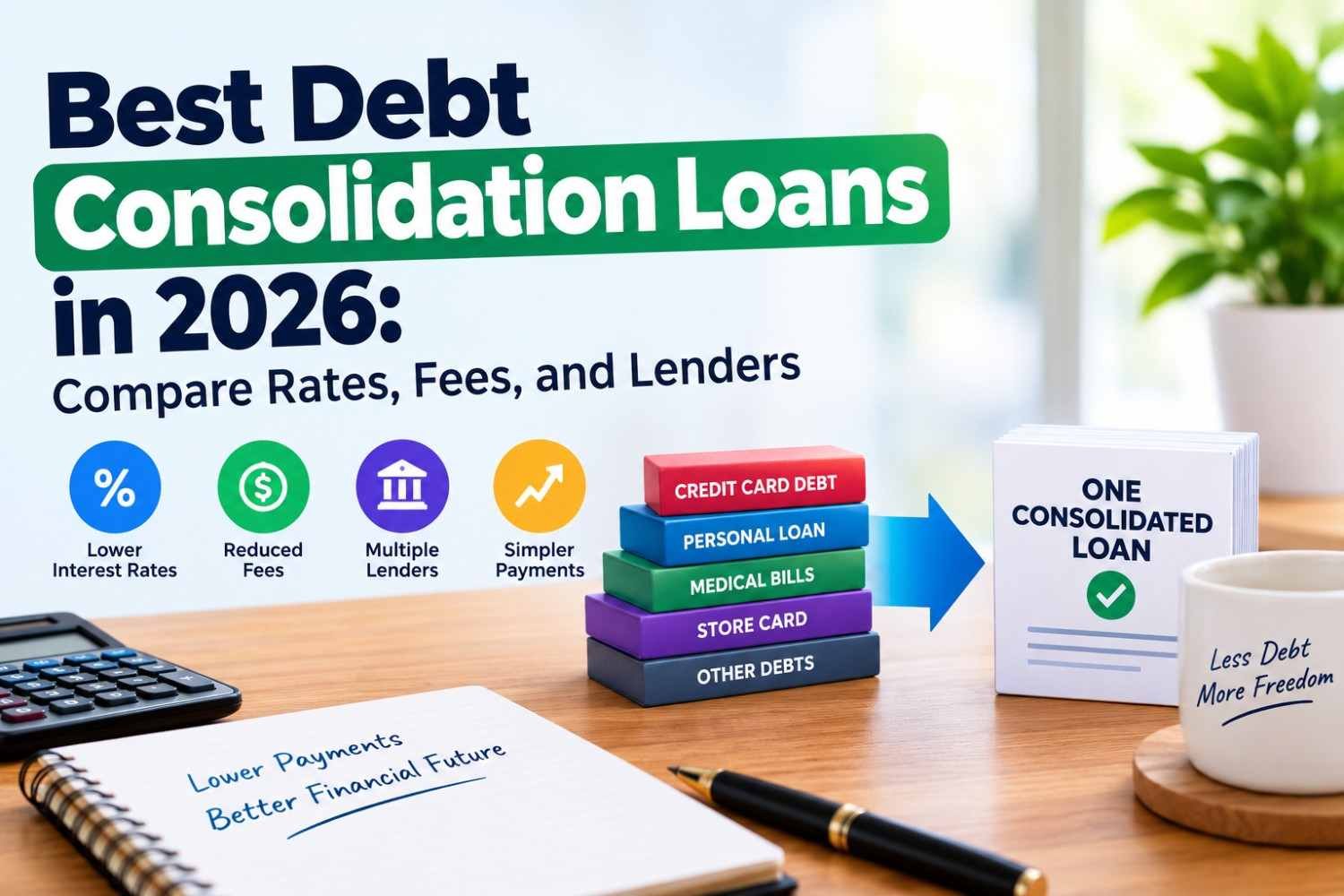
Managing multiple credit card balances, personal loans, and other high-interest debts can make monthly budgeting difficult. Different payment dates, varying interest rates, and growing balances can create financial stress for borrowers who want a more organized repayment strategy.
The best debt consolidation loans can help eligible borrowers combine several debts into one personal loan with a single monthly payment. Depending on your credit profile and the terms you qualify for, consolidating debt may also reduce interest costs and make repayment easier to manage.
However, not every debt consolidation loan is affordable, and a lower monthly payment does not automatically mean you will pay less overall.
In this guide, we compare leading debt consolidation lenders, explain interest rates and origination fees, discuss credit score requirements, and show you how to evaluate loan offers before applying in 2026.
What Is a Debt Consolidation Loan?
A debt consolidation loan is generally a personal loan used to pay off multiple existing debts. Instead of making separate payments to several credit card companies or lenders, you repay the new loan through one scheduled monthly payment.
Many borrowers use debt consolidation loans to manage high-interest credit card balances. Depending on the lender and loan agreement, funds may be deposited into your bank account or sent directly to eligible creditors.
For example, suppose you have three credit cards with different balances and interest rates. You might qualify for a personal loan that pays off those balances and replaces them with one fixed-rate loan.
The financial benefit depends on the new loan’s annual percentage rate (APR), fees, repayment term, and your existing debt costs.
Best Debt Consolidation Loans in 2026
When comparing the best debt consolidation lenders, consider the APR, origination fees, available loan amounts, repayment terms, credit requirements, and whether the lender pays creditors directly.
The following lenders and lending platforms are options worth researching. Their products, eligibility requirements, and rates can change, so verify current terms before applying.
1. SoFi — Best for Borrowers With Strong Credit
SoFi offers personal loans that eligible borrowers may use to consolidate debt. It is worth considering if you have a strong credit profile and want to compare larger loan amounts and flexible repayment periods.
Features to review:
- Available personal loan amounts and repayment terms.
- Whether direct creditor payments are available.
- APR and any applicable fees.
- Autopay discounts and other eligibility conditions.
- Minimum income and credit requirements.
SoFi may suit borrowers with strong credit histories, but advertised rates are not guaranteed. Your approved rate depends on factors such as creditworthiness, income, loan amount, and repayment term.
2. Discover — Best for Comparing Loan Fees
Discover is another lender to investigate when comparing personal loans for debt consolidation. Its published loan terms and fee structure may be attractive to borrowers looking for straightforward repayment costs.
Features to review:
- APR offered for your credit profile.
- Whether an origination fee applies.
- Available loan amounts.
- Repayment options and payment dates.
- Direct payment options for eligible creditors.
Always compare the total cost of the loan rather than choosing a lender solely because it advertises fewer fees.
3. Upgrade — Best for Flexible Repayment Options
Upgrade offers personal loans with multiple repayment-term options and debt consolidation features. It may be worth comparing if you need flexibility when selecting a monthly payment.
Features to review:
- Available loan amounts and repayment periods.
- Origination fees.
- Direct creditor payment options.
- Autopay discounts, if available.
- The total interest payable over the loan term.
A longer repayment period can reduce your required monthly payment, but it may increase the total interest you pay.
4. Happy Money — Best for Eligible Credit Card Debt
Happy Money offers loans designed for credit card debt consolidation. It is particularly relevant for borrowers whose main objective is to replace qualifying credit card balances with a structured repayment plan.
Features to review:
- Whether your existing debts qualify.
- Minimum and maximum loan amounts.
- APR and origination fees.
- Available repayment terms.
- Whether funds are sent directly to creditors.
Check the loan’s permitted uses before applying because a product designed for credit card debt may not cover every type of outstanding balance.
5. Upstart — Best for Exploring Different Eligibility Factors
Upstart is an online lending platform that evaluates applicants using its underwriting criteria, which may include factors beyond a traditional credit score.
It may be worth exploring if you are comparing personal loan offers and want to understand how your financial profile affects eligibility.
Features to review:
- Loan eligibility and minimum requirements.
- APR and origination fees.
- Available loan amounts and terms.
- Whether checking an initial rate involves a soft credit inquiry.
- Final approval conditions.
No lender can guarantee approval, and a broader evaluation process does not mean every applicant with limited or poor credit will qualify.
Important: These are research options, not a definitive ranking of the five cheapest loans. Compare current written offers using the same loan amount and repayment period before deciding.
Debt Consolidation Loan Rates and Fees in 2026
The interest rate you receive is one of the most important factors when choosing a debt consolidation loan.
Lenders generally assess credit history, income, existing debt obligations, loan size, and repayment term when determining the rate offered to an applicant.
Borrowers with stronger credit profiles may qualify for more favorable terms, while applicants with weaker credit may receive higher APRs or fewer loan options.
What Is APR?
Annual percentage rate, or APR, represents the annualized cost of borrowing and generally incorporates interest and certain mandatory loan fees.
Comparing APRs can help you evaluate competing offers more accurately than comparing interest rates alone.
However, you should also review the repayment period and total amount payable. A loan with a lower APR but a much longer term may still cost more overall.
Common Debt Consolidation Loan Fees
Before accepting a loan, check for these potential charges:
- Origination fee: A fee charged for processing or arranging the loan, sometimes deducted from the money you receive.
- Late payment fee: A charge that may apply when you miss a scheduled payment.
- Returned payment fee: A possible charge for a failed payment, depending on the agreement.
- Prepayment penalty: A potential fee for paying off a loan early, although many personal loans do not impose one.
For example, if you borrow $10,000 and the lender deducts a 5% origination fee, you would receive $9,500 while the repayment obligation may still be based on the $10,000 principal. Always confirm the exact loan structure in your agreement.
How to Compare Debt Consolidation Loans
Choosing the best debt consolidation loan involves more than finding the lowest advertised rate. Use the following checklist to evaluate lenders.
| Comparison factor | What to check |
|---|---|
| APR | Compare the actual rate offered to you |
| Origination fee | Calculate the amount deducted or added |
| Monthly payment | Make sure it fits your budget |
| Loan term | Compare the total repayment period |
| Total repayment | Calculate principal, interest, and applicable fees |
| Direct creditor payment | Check whether the lender can pay eligible creditors |
| Credit inquiry | Confirm whether prequalification uses a soft inquiry |
| Early repayment | Review any restrictions or penalties |
Requesting prequalification from multiple lenders can help you compare potential offers. When available, soft credit inquiries generally do not affect your credit score, but submitting a full application may trigger a hard inquiry.
Read each lender’s disclosures before proceeding.
How Much Can You Save With a Debt Consolidation Loan?
Your potential savings depend on the interest rates and fees attached to your existing debts compared with the new loan.
Consider this illustrative example:
Suppose you have $10,000 in credit card debt with an average APR of 25%. You are considering a $10,000 consolidation loan with a 15% APR and a 36-month repayment period.
Using standard fixed-payment amortization and assuming no additional fees:
- Existing debt: $10,000 at 25% APR.
- New loan: $10,000 at 15% APR.
- Repayment period for the comparison: 36 months.
- Estimated monthly payment on the new loan: approximately $347.
- Estimated total of the new loan payments: approximately $12,490.
These figures are illustrative, not a lender quote. Actual payments and savings depend on the precise rates, fees, repayment schedule, and terms of your existing accounts.
To calculate meaningful savings, compare the total cost of repaying your current debts over a realistic period with the full cost of the consolidation loan. Include origination fees and any charges associated with closing existing accounts.
Can You Get a Debt Consolidation Loan With Bad Credit?
Getting approved for a debt consolidation loan with bad credit may be more difficult, but some lenders consider applicants with fair or less-than-perfect credit.
The terms offered may be significantly more expensive than those available to borrowers with strong credit.
Before applying, consider these steps:
- Review your credit reports for errors.
- Calculate your monthly income and existing debt payments.
- Check whether a lender offers prequalification.
- Compare the APR and fees on every eligible offer.
- Avoid borrowing more than you need to repay qualifying debts.
If available loans carry very high interest rates, alternatives such as nonprofit credit counseling or a debt management plan may be worth investigating.
Be cautious about lenders or debt relief companies that promise guaranteed approval, demand upfront payments without clear disclosures, or pressure you to make an immediate decision.
Debt Consolidation Loan vs. Balance Transfer Credit Card
Both options can help eligible borrowers manage credit card debt, but they work differently.
| Feature | Debt consolidation loan | Balance transfer card |
|---|---|---|
| Repayment | Usually fixed monthly payments | Minimum payments under card terms |
| Interest | Often a fixed APR | May offer a promotional 0% APR |
| Fees | May include an origination fee | May include a balance transfer fee |
| Credit requirements | Vary by lender | Promotional offers often require good credit |
| Repayment discipline | Set repayment schedule | Promotional period expiration matters |
A balance transfer card may be useful if you qualify for a low-cost promotional period and can repay the balance before the offer expires. A personal loan may be more suitable if you prefer a defined repayment schedule.
Compare the promotional period, transfer fees, post-promotion APR, loan costs, and your realistic repayment capacity.
Pros and Cons of Debt Consolidation Loans
Advantages
- One monthly payment can simplify debt management.
- A lower APR may reduce interest costs.
- Fixed repayment terms can make budgeting easier.
- Direct creditor payments may simplify the payoff process.
- A defined repayment schedule can help you work toward becoming debt-free.
Disadvantages
- Origination fees can reduce the value of consolidation.
- A longer term may increase total interest costs.
- Applicants with poor credit may receive expensive offers.
- Paying off credit cards does not prevent new balances from accumulating.
- Missing payments on the new loan can damage your credit history.
Debt consolidation works best when it is combined with a realistic budget and a plan to avoid accumulating additional high-interest debt.
How to Apply for a Debt Consolidation Loan
Follow these steps before choosing a lender.
Step 1: Calculate your total debt. List each balance, APR, minimum payment, and creditor.
Step 2: Check your credit profile. Review your credit reports and correct any errors before applying.
Step 3: Estimate an affordable payment. Account for housing, utilities, insurance, food, emergency savings, and other essential expenses.
Step 4: Compare multiple lenders. Request eligible prequalification offers and compare APRs, fees, terms, and total repayment amounts.
Step 5: Review the loan agreement. Confirm the amount you will receive, the payment schedule, the total cost, and the rules for direct creditor payments.
Step 6: Pay down the intended debts. If funds are deposited into your account, use them for the intended debt repayments rather than additional spending.
Step 7: Follow a repayment plan. Make payments on time and monitor your remaining balance.
Frequently Asked Questions
What is the best debt consolidation loan in 2026?
The best debt consolidation loan depends on your credit profile, debt amount, income, preferred repayment period, and the terms you qualify for. Compare multiple lenders and choose based on total borrowing cost rather than advertising claims alone.
What credit score do you need for a debt consolidation loan?
There is no universal minimum credit score. Each lender sets its own eligibility criteria, and approval may depend on income, existing obligations, credit history, and other underwriting factors.
Are debt consolidation loans worth it?
They may be worthwhile if the new loan reduces your total borrowing costs or provides a more manageable repayment structure. Compare APR, fees, repayment term, and total payments before deciding.
Does debt consolidation hurt your credit score?
Applying for a loan may result in a hard credit inquiry, which can temporarily affect your score. Paying off revolving credit card balances may improve credit utilization, but results vary. Missed payments or new debt can have negative effects.
Can I consolidate credit card debt with a personal loan?
Yes, some personal loans are designed for credit card debt consolidation. Check whether the lender permits your intended use and whether it offers direct payments to creditors.
Is debt consolidation better than debt settlement?
They are different strategies. Consolidation replaces multiple debts with a new loan, while debt settlement involves negotiating to pay less than the full amount owed. Settlement can carry credit, tax, fee, and collection risks. Consider qualified financial or legal guidance if you are struggling to meet payments.
Can I get a debt consolidation loan without collateral?
Many personal debt consolidation loans are unsecured, meaning they do not require a home or vehicle as collateral. Approval and rates still depend on the lender’s eligibility requirements.
Final Thoughts
Finding the best debt consolidation loans in 2026 requires careful comparison of interest rates, origination fees, repayment terms, and eligibility requirements.
SoFi, Discover, Upgrade, Happy Money, and Upstart are potential starting points for researching personal loan options, but the right choice depends on your financial situation and the offers available to you.
Before applying, compare the total repayment cost of each loan with your existing debt obligations. If consolidation does not provide a meaningful financial benefit, explore alternatives such as a balance transfer card, a nonprofit credit counseling service, or a debt management plan.
A well-planned repayment strategy can help you simplify your finances, control borrowing costs, and work toward long-term financial stability.